
by Ann Lambert
Jr Comp Tried Telemark and Learned Ski History Along The Way
If mid-March rolls around and you’re not ready for the Nordic season to end, try telemark! Jr. Comp did. On March 21st, Jr. Comp skiers and their families gathered at ExpertVoice headquarters in downtown Salt Lake City for food, stoke, and a trip through free-heel history. The next day, after being properly amped and educated, kids and their families took to the slopes at Alta Ski Resort to try the downhill Nordic technique.
What is Telemark Skiing?
Telemark skiing has occupied a sometimes obscure niche within the Nordic family. It’s a downhill style in which free-heel skiers descend using a fluid, lunging motion, settling into a “telemark stance”—one ski forward, the other back, upper body low and balanced—before repeating the sequence in the opposite direction. It’s a bit slower than alpine and a lot more nuanced, but the feeling of linked telemark turns is like nothing else. The difference between alpine and telemark turns is often described as akin to the difference between driving an automatic and a stick-shift car. I like to think of it as the difference between flying as a drone and flying as a bird, though admittedly I’ve never been either.
Much like the structure of the turn itself, telemark’s popularity has ebbed and flowed, shaped by the technique’s unique assets and demands and the shifting historical and geographic contexts of skiing. At the March 21st gathering, participants followed these cycles through living history lessons presented by three figures whose lives have profoundly shaped the sport and its survival: Dave Hanscom, RJ Guiney, and Josh Madsen.
Dave, RJ, and Josh
TUNA comp coach Jen Santoro called Dave Hanscom more than a living legend. “Dave,” she said, “is an essence.” It fits. An Alf Engen Hall of Fame inductee, his impact on skiing is firmly cemented. Hanscom is, without exaggeration, the architect of Nordic backcountry skiing in the Wasatch. He literally wrote the book. Wasatch Tours (1976), coauthored with Alexis Kelner, remains the definitive guide to safe ski touring in the Wasatch backcountry. He also helped steer the selection of Soldier Hollow for the 2002 Olympic Games, the benefits of which we are still enjoying nearly a quarter century later, especially during this record-low snow season. And then there are the two really big ones for our community in particular: Hanscom served many years as an advisor to The Utah Nordic Alliance and was the director for The Wasatch Citizen Series.
RJ Guiney is another pillar of the Wasatch Nordic community who shaped today’s ski culture. An early organizer and competitor in The Wasatch Citizen Series, he later studied telemark racing and brought those insights home, launching Utah’s first organized telemark race series, The Wasatch Telemark Series, in the 1980s. This race series ran into the 1990s—long enough to include a young Josh Madsen at the start of his telemark ski career.
Josh Madsen inspired my own telemark journey almost thirty years ago, when we were kids “peer-instructing” at Brighton’s ski school. At 16 years old, Josh already had a tele-god reputation around Brighton, which, it turned out, was very much deserved. Josh skied in Warren Miller’s 2005 film Higher Ground and produced, filmed, and edited many of his own telemark movies. He owns Telemark Ski Magazine and founded World Telemark Day. Throughout it all, he sustained Freeheel Life—now an online hub for learning telemark’s history, buying gear and parts, and arranging kids’ season rentals.
Telemark Started in Telemark
As kids and families arrived at the Boston Building, Josh’s telemark films played on the big screen while they munched and mingled. Nearby, Josh, RJ, and Dave talked shop. Once everyone was settled, Madsen opened the presentations, beginning at the very beginning.
Skiing, he explained, started as a practical way to move across deep snow in Northern Europe. Walking on wooden planks attached to the toes kept people from sinking. By the mid-19th century, skiing had taken a recreational turn as well. Ski racing and jumping were popular pastimes, but the skis and techniques they used recreationally were no different than the ones used for transportation. Then, in Telemark, Norway, the sport took a dramatic leap forward when Sondre Norheim developed a new way to tackle the downhill: the telemark turn. This flowing, downhill technique continued to allow for climbing and traversing, but it also made the descent faster and more controlled. The telemark turn spread quickly, becoming the dominant ski racing style across the Alps.
Norheim dabbled in ski design, too. He experimented with shorter skis and early sidecuts— similar to modern alpine skis. Fatefully, and a bit ironically, he also introduced the Christiania turn, which supplanted telemark, eventually leading to a fixed heel turn. The shift marked the first true split between Nordic and alpine skiing, and the beginning of telemark’s first long ebb. For decades, the technique existed in a state of relative hibernation, practiced mainly among older skiers and in communities with strong Nordic roots.
Backcountry Resurgence
Dave and RJ picked up the story in the 1970s, when telemark saw a resurgence driven by backcountry skiers. As resorts expanded and lift lines grew, a countercultural wave of skiers turned to the backcountry in search of a more authentic mountain experience. To do this, they needed different tools and techniques: Nordic tools and techniques. On classic cross-country skis of the day, the telemark turn was rediscovered. Gliding through the wilderness on wooden cross-country skis, guided by Dave Hanscom’s book Wasatch Tours, and influenced by Steve Barnett’s book, Cross-Country Downhill and Other Nordic Mountain Skiing Techniques, a new era of telemark flow emerged.
Dave and RJ, central figures of that time, brought it to life at the event with props and photos. They traced backcountry telemark gear’s evolution from soft leather boots and long wooden skis to stiff plastic boots and shorter, shaped skis akin to the alpine variety. They projected images of early Wasatch Telemark Series races and gutsy backcountry long jump contests deemed too risky for resorts. The audience marveled at skiers charging waist-deep powder on skis barely three fingers wide—and at the fact that one of the race series, The Deseret Cup, held an event in Sugarhouse Park… on March 11th.
When presentations and demonstrations ended, office chair races ensued until parents regained the upper hand. The kids put the place back in order, finished the telemark movies, ate third desserts, and adored the baby pigeon nestlings outside one of the building’s windows. Not long after sunset, the event came to a close.
Personal Reflections
At the party, I didn’t share my observations of how telemark continued to evolve to the present day, but I will here.
Boots and bindings got stiffer, making telemark an attractive option for both lift-served and backcountry skiing. By the middle of the first decade of this century, telemark surged from niche to craze. At resorts like Bridger Bowl, Montana, it sometimes seemed more than half the skiers were dropping a knee. In the backcountry, telemark was near universal. Yet, it was the backcountry flavor the sport had acquired that sowed its eventual ebb in the 2010s; a turn in history that echoed Norheim’s ironic legacy of bringing telemark into the world as well as the Christiania technique that led to its decline. As all-terrain (AT) gear improved—lightweight for climbing but lockable for downhill—skiers who thought of telemark as a backcountry tool abandoned it, and telemark again slipped into another hibernation, albeit less deep or long as the previous.
The market contracted but never disappeared. It even continued to evolve to suit the remaining holdouts like me. But, eventually, I found myself unable to adopt the even stiffer equipment of the New Telemark Norm (NTN). Worried about my knees in non-releasable bindings, and noticing the longer quad recovery time my aging body required, I finally decided to lock my heels during the winter of 2023–2024. It only took ten days in alpine gear to blow out my knee when my releasable bindings failed to do just that.
After two surgeries and a lot of time off snow, I finally returned to telemark this year and noticed something had changed while I was gone. People were interested in telemark again. There were more of us on the mountain, and rare was the lift ride that a fellow skier didn’t comment on my gear or ask about the technique. Even children took note. When I saw TUNA kids at ski practice attempting the iconic turn in their classic skis, I decided the ebb was once again over, and a new flow had begun.
Inspiring the Next Generation
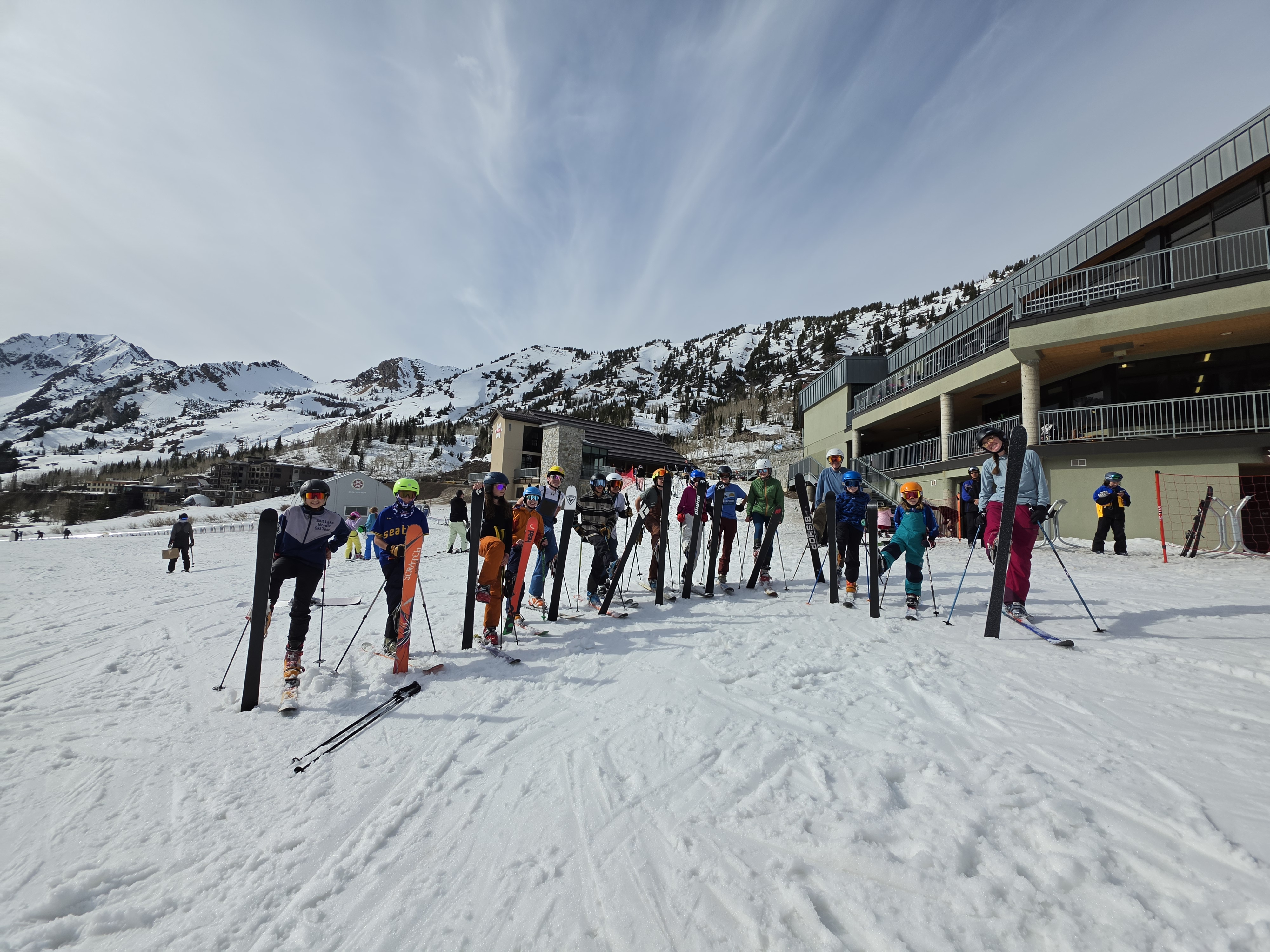
The on-snow day arrived. With Josh’s generously loaned Freeheel Life gear and a few setups donated by the public, the group reconvened at Alta to try telemark. It was sunny and warm; the snow slushy and playful—perfect for learning a new technique. There was no formal lesson, no instructor. The only guidance came from a dryland telemark stance exercise I led the night before and a few on-snow tips during their experimentation. But the kids didn’t need a lesson. Adding a lunging turn to the balance and weight transfer skills they honed in their TUNA cross-country programs meant that within an hour and a half, all 14 kids were making telemark turns.
Will TUNA kids claim a stake in the now rising flow of telemark history? Maybe. It took a lot of effort to pull it off, and it will take a lot more to keep it going, but there’s plenty of reason for optimism. The kids had fun. Some started a group chat called free-the-heel, free-the-mind, which made me laugh and also made me proud (so I didn’t tell them about the counter slogan, fix-the-heel, fix-the-problem). One of the biggest obstacles, should they want to continue, will be equipment access. The kids in the group chat self-organized a second meet-up the following weekend, but they had to alpine ski because they didn’t own telemark gear. It’s not a simple problem to solve, especially because young kids’ telemark boots are no longer manufactured. 22 Designs makes kids’ bindings, and mounting them on alpine skis is a decades-old hack. Yet, there’s really no way around the boot issue.
So, where to go from here? Well, the first place I’d go if I had a little aspiring teleskier would be freeheellife.com. Josh has the largest collection of used kids’ telemark season rental packages that I’m aware of, and he offers them at a very reasonable price. He’ll ship anywhere in the US. And the bigger kids? One day, they may have the resources and desire to invest in the sport by purchasing new equipment but, in the meantime, I’m working on something. Inspired by the generous gear donations I received from the public, I’m building an inventory of donated or affordably acquired telemark gear. I’m calling it The Little Free(heel) Library. Hopefully, next year, when mid-March rolls around, I’ll have something you and your big kids can check out, like a library book, free of charge. I’ll keep you posted.
